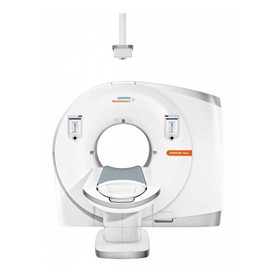
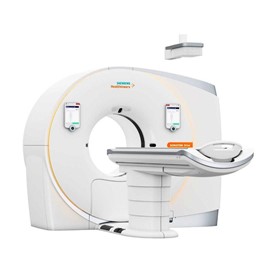
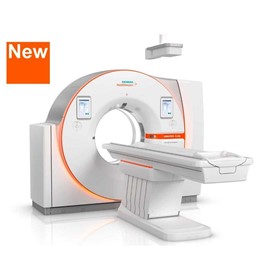
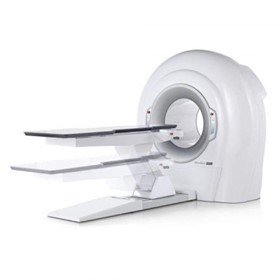
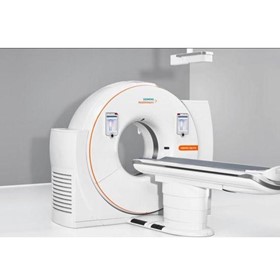
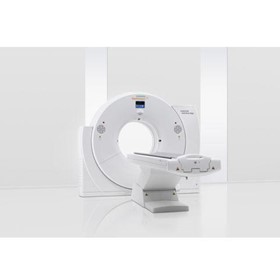
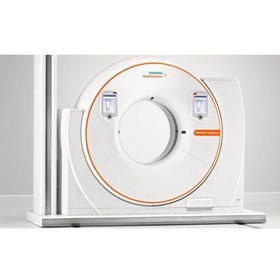
????????Millions of patients around the world are still waiting toreceive the standard of care they need and in an affordable way. Healthcareproviders are seeking better technology to help more patients and drive betteroutcomes. Simple and fast, CT is arguably the most valuable diagnostic imagingtool in healthcare. Yet its capacity to improve patient care is far fromtapped. All revolutions start somewhere. Our revolution began with theRevolution CT system — designed from the ground up for pioneering the future ofCT. Now we introduce Revolution ACT. Revolution ACT is designed not only as aproduct, but as a solution to help you provide better patient care — andprovide it to more patients. It’s the centerpiece of our commitment to help youachieve your CT services aims.
You’ll find many of the technologies inherited from our mostadvanced Revolution CT system – like the new Clarity panel detector, new userinterface, or Organ Dose Modulation. Helping you feel more confident aboutmoving to the next level, clinically and economically — that’s intelligentinnovation.
Revolution ACT: It’s exactly what’s needed to help youachieve success. And exactly what you’d expect from GE.
CORE TECHNOLOGIES
Clarity Panel Detector
Highly innovative segmented panel designs built withadvanced packaging and miniaturization technology for lower power consumptionand improved thermal performance. Since thermal control is localized on theintegrated panel, the detector achieves better precision in performance andreduces the detector startup time.
The higher density of interconnects and modern A/D chipsdeliver better signal linearity with fast response time. An integrated DAS onDetector or DoD design, the analog signal transmission length from Detector toDAS is cut to a virtual zero reducing noise by up to 20% and improving imagequality
Overlapped Reconstruction
A higher sampling density provides better representation ofthe original signal and can potentially lead to improved image quality andfidelity. The term “conjugate samples” refers to two projection samples thatare 180º apart in their respective projection angle, but at an equal distanceto the isocenter.
Taking both sets of projection measurements intoconsideration, we obtain a significantly increased sampling density and,therefore, potentially improve the overall acquisition. Using GE’s novelconjugate cone beam reconstruction algorithm, the conjugated rows ofprojections are considered jointly in the back projection step and deliversimproved Z-axis visualization performance. Conjugate cone-beam acquisitionenables 32-slice imaging on Revolution ACT.
Ultra Kernel
Adaptive Enhance Level Adjustment (AELA) can improve visualspatial resolution while maintaining pixel noise standard deviation andartifact. This kernel maybe helpful in enhancing the visualization of smallanatomical structures with high contrast. Combine with sub millimeter slicethickness acquisition, Revolution ACT allows imaging at higher spatialresolution and greater detail of small
Smart Dose with ASiR
ASiR uses statistical modeling to remove noise in imageswhile preserving anatomical detail. This enables a same- or better-qualityimage to be produced with lower tube current or tube voltage, thus lower dose,for all CT applications in which it is used. ASiR is one of the key dosereduction technologies flowing down from our premium product line. ASiR is themost-used dose-lowering software in the industry.
It allows healthcare providers to lower dose by up to 40% totheir patients as compared to standard image reconstruction without reducingimaging quality. ASiR also improves low-contrast detectability and can haveequivalent IQ to an acquisition with 1.67 times the mA2. Operators can managelonger coverage scans easier.
The maximum tube power and current of ASiR allows achievingthe same image quality at a lower mA with less tube heat output, which enablesthe tube for longer duration under helical scan. Revolution ACT performancewill be equivalent to 40KW and 333mA (@120kV, 3.3MHu tube heat capacityequivalence with ASiR). This improved efficiency helps lower power consumptionand operational costs to the administrators.
Smart Dose: Organ Dose Modulation (ODM)
Organ Dose Modulation (ODM) is a scan mode that wasdeveloped to reduce dose via x-ray tube current modulation for superficialtissues such as breasts, eyes, gonads etc. ODM was developed to provide thedose reduction goal of a shield material without the negative effects it mayhave on imaging performance. ODM not only reduces the dose to the sensitiveorgan by up to 40% but also optimizes the overall dose while maintaining thenoise index (NI) value selected by the user.
Smart Dose: Advanced Noise Reduction Tech. (ANRT)
ANRT Is a reconstruction technology used to reduce the noiseof diagnostic images and retain detailed information of the image structure.ANRT noise-reduction technology can, while maintaining image noise level,lessen the dose of some X-ray testing, or improve image noise level and imagequality. ANRT is only applicable on digital oblique images.
Smart Dose: Volumetric image Space Recon (ViSR)
Volumetric Image Space Reconstruction (ViSR) helps reduceartifacts and noise without compromising resolution. It contains an adaptivefilter that is designed in the projection space with the filter parametersdynamically adjusted to adapt to the local noise characteristics such that theamount of smoothing operation is based on the x-ray flux level at eachprojection channel. In anatomical regions such as the brain, this 3D filterreduces noise without compromising resolution, for clear visualization of brain,tumor, and pediatric cases. With ViSR the scanner delivers up to 20% imagequality improvement at the same dose, or the same image quality with up to 36%dose reduction.
Smart Flow: pitch booster with IQ Enhance
IQ Enhance is an advanced algorithm to reduce helicalartifact in thin-slice helical scanning. The Revolution ACT scanner with thisfeature can accelerate its helical pitch up to 3.0x when acquiring the samehelical artifact level compared with the same scanner with IQ Enhance disabled.Use of IQ enhance (IQE) along with sub-second rotation speed allows fasterpitch scanning covering more anatomy at similar image quality.
Smart Flow: new user interface
Smart Flow with new user interface: the workflow and userinterface have been completely redesigned with continuous feedback from a crosssection of technologists and radiologists to make it easy-to-learn and use. Theworkflow features a modern look and feel that is inspired by our Revolution CTproduct. Many steps of the user experience have been reworked right frompatient entry, to protocol selection, to monitoring and processing the patientscan. Smart new features include a simple and advanced mode – where users canswitch between the modes at the click of a button.
Smart Flow: volume helical digital tilt
Volume helical digital tilt is an innovation in imagereconstruction technology that allows clinicians to reconstruct tilted views ofup to 30 degrees without the need for physically tilting the scanner. Digitaltilt uses a novel resampling technology within the reconstruction pipeline tomap vertical data samples to user specified tilted view angle. Digital tiltexams are more efficient since operators can setup the entire workflow fromtheir console without the need for multiple trips between console and gantrycontroller. With a volume helical acquisition, clinicians have the additionaladvantage of leveraging powerful post processing and visualization tools forcreating volume rendering, multiplanar reformatting (MPR), and curved MPR viewsas needed.
Smart Flow: spectral calibration
Spectral calibration calculates the beam hardening vectorsbased on a theoretical model of x-ray attenuation through beam-path and thedata from scanning a 20 cm water phantom. Applying the result from spectralcalibration in reconstruction, the uniformity of the CT numbers in image,especially the off-center image, is improved compared with the conventionalbeam hardening correction method.
Specifications:
Gantry Specifications
Aperture | 65 cm |
Maximum SFOV | 43 cm |
Focal spot to detector distance | 94.9 + 0.1 cm |
Tilt | + 30 degrees (digital) |
Rotation Speed | 0.6, 0.98, 1.0, 1.2, 1.5, 2.0, 3.0, 4.0 seconds |
Laser Alignment | Internal & external with + 1 mm accuracy |
Tube
Anode Heat Storage | 2.0 MHU and 3.3MHU equivalent with ASiR |
Anode Heat Dissipation (max) | 6200W (500 kHU/min) |
Focal Spot | 0.8 mm (W) x 0.6 mm (L) Nominal focal spot size (IEC 60336:2005) |
Tube Current (max) | 200 mA and 333mA equivalent with ASiR |
Power Generation
Generator | NEW Compact Generator |
Maximum Power | 24 kW and 40kW equivalent with ASiR |
kV Modes | 80 / 100 / 120 / 140 |
x-ray Current (max) | 200 mA and 333mA equivalent with ASiR |
Patient Table
Vertical Scannable Range | 700mm- 900mm |
Maximum Horizontal Range | 1520 mm |
Maximum Vertical Range | 441mm-900mm |
Maximum Scan Range | 1350 mm (with extender) |
Movement Speed | 0.5 mm/sec to 100 mm/sec |
Loading Capacity | 180 kg (400 lb) |
Positioning Accuracy | 0.25 mm |
Imaging System
Detector | Clarity panel detector HiLight: scintillator with DAS on detector (DoD) |
Slices per rotation | Up to 32-slice |
Slice Thickness | 0.625 mm – 20.0 mm |
Reconstruction Frame Rate | Up to 22 |
Maximum helical pitch | 1.75:1 |
Scan Field of View (SFOV) | Pediatric, Adult Head, Small Body, Large Body |
Integrated console computer
CPU | Intel Xeon E5 Series CPU |
Maximum Internal Memory | 16GB |
Disk Storage Capacity | 1 TB |
Display Monitor | 21.5” color LCD monitor |
Highest resolution | 1920 x 1080 |
Display GPU | AMD FirePro Series Graphics Card |
Reconstruction GPU | AMD FirePro Series Graphics Card |
OTHER FEATURES
Smart Flow
- Emergency patient mode
- SmartPrep
- Dynamic Transition
- Enhanced filming workflow
- Real-time scout
- Connect Pro
- 10 PMR
- AutoTransfer
- User interface
- Desktop overview
- Exam Rx
- Patient scheduling
- Patient data entry
- Exam protocol selection
- Protocol view/edit
- Scan data acquisition
- Dose computation & display
- Auto image management
- ImageWorks
- Image access
- Routine image display
- Routine measurements
- Image annotation
- Manual image filming
- Image management
- Image networking
Helical Multi-Slice Modes
- Slices per Rotation Up to 32-slice*
- Slice thickness modes, mm 0.625, 1.25, 2.5, 3.75, 5,
7.5, 10, - Rotation speed 0.98, 1.0, 1.2, 1.5, 2.0
- Available pitch 0.625 to 1.75 with multiple
options in between
0.563:1, 0.938:1. 1.375:1,
1.75:1 0.625:1, 0.875:1,
1.35:1, 1.675:1, 0.75:1,
1.5:1, 1:1 - Minimum inter-group delay, s 1.0
- Minimum scan-to-scan cycle, s 1.0
- Minimum pixel size, mm 0.19
- DFOV selection cm 9.6 – 43
- Table movement speeds, mm/s 3.75 – 35
Axial Multi-Slice Prescription
- Slices per rotation Up to 32-slice
- Slice Thickness Modes, mm 0.625, 1.25, 2.5, 3.75, 5, 7.5, 10
- Rotation Speed, s 0.98, 1.0, 1.2, 1.5, 2.0, 3.0, 4.0
- Minimum Interscan Delay (ISD), s 1.0
- Incremental Gantry
- Display, mm 0.5
- Minimum scan-to scan cycle s 1.0
Software Clinical Applications
- Dynamic Volume Review for Fast Screening
- Curved Volume of Interest
- Protocol Management and Loading
- Review Layout Presets
- Multiple VR Objects Merge
- Pseudo Surface Shading Mode
- Predefined Cut Planes
- VR Preset save/recall
- 3D Rendered Lumen View
- Automatic Path Tracking
- Path Bridging (in case of occlusions)
- SmartCursor for Easy Navigation
- Synchronized Reformatted Views
- Cut visualization mode
- Multi-planar reconstruction (MPR)
- Multi-planar volume reconstruction (MPVR)
- 3D surface, 3D MIP, and 3D volume rendering
- ImageWorks
Software Clinical Applications - Advanced
- AutoBone™ Xpress
- Advanced Vessel Analysis Xpress
- Navigator – Virtual Endoscopy
- Neuro DSA
- DentaScan
- Advantage CTC Pro3D EC
- CT Perfusion 4D – Multi Organ
- CT Perfusion 4D – Neuro
- Biopsy Rx
Read less...
To contact Mediquip about GE Healthcare CT Scanner | Revolution ACT use Get a quote.








-375x300-280x280-state_7.jpg)