
Key takeaways
- New stationary concentrator prices (2026): 5L units $1,000-$2,500 AUD; 8-10L units $2,500-$5,500; 15L+ clinical units $5,000-$10,000+. Used/refurbished from $500.
- Annual running cost: $350-$700 for a 5L home unit covering electricity ($250-$350), filters ($50-$100) and annual service ($100-$250). 10L units run $550-$1,000/year.
- 5-year TCO for a 5L home unit: $2,800-$5,500 all-in, including purchase, electricity, filters, sieve bed replacement and one major service.
- Concentrator vs cylinder cost: A home patient using 2 LPM for 16 hours/day spends $250-$350/year on electricity with a concentrator versus $2,500-$4,000/year on cylinder refills - the concentrator pays for itself within 6-12 months.
- If you manage 5+ units: Fleet pricing from major distributors reduces per-unit cost by 10-20% and typically includes bundled service contracts.
- Depreciation: ATO effective life 5-10 years for medical equipment; diminishing value rate 20-40%. The instant asset write-off threshold covers most 5L units.
What stationary oxygen concentrators actually cost in Australia
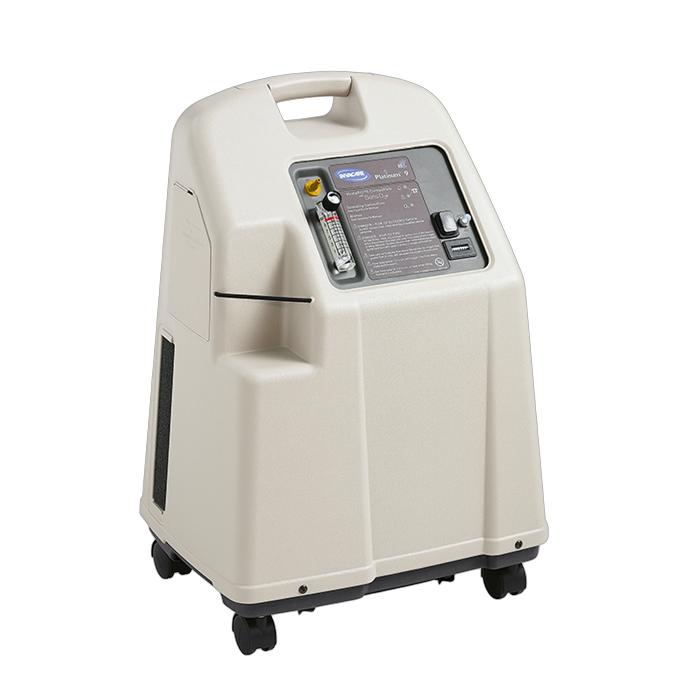
Stationary oxygen concentrators are low-capital medical devices where the purchase price is typically the smallest component of the ownership cost. Electricity, filter consumables, sieve bed replacement and servicing accumulate over a 5-8 year ownership period and are the numbers that matter for budget planning - particularly for home care providers and aged care facilities managing multiple units across a fleet. The cost advantage over cylinder-based oxygen supply is substantial: a concentrator eliminates ongoing refill costs entirely, replacing them with a predictable electricity draw.
This guide breaks down every cost layer for 5L, 10L and clinical-grade concentrators in the Australian market. For flow rate selection, specifications and supplier evaluation, see the stationary oxygen concentrator buying guide on MedicalSearch.
Buyers where concentrator cost modelling is most relevant:
- Home care providers budgeting NDIS or DVA-funded equipment fleets
- Aged care facilities costing bedside oxygen capacity across multiple rooms
- Respiratory clinics comparing concentrator purchase vs cylinder rental
- Individual patients evaluating out-of-pocket purchase vs rental
Choose your price bracket by flow rate
Before modelling costs, confirm the flow rate category. This sets the purchase price, power draw and consumable profile for the entire ownership period.
Category | Price Range (AUD) | Typical Buyer |
|---|---|---|
5L standard (new) | $1,000-$2,500 | Home patients, aged care bedside |
8-10L high-flow (new) | $2,500-$5,500 | Severe COPD, clinical treatment rooms |
15L+ clinical (new) | $5,000-$10,000+ | Hospital wards, high-dependency, dual-patient |
Used/refurbished (5L) | $500-$1,200 | Check sieve bed hours and compressor condition |
Rental (5L monthly) | $80-$200/month | Short-term therapy, trial before purchase |
If all patients are prescribed 5 LPM or below, a $1,000-$2,500 unit is the right price bracket. For prescriptions above 5 LPM, budget $2,500-$5,500 for an 8-10L unit. Rental at $80-$200/month suits short-term post-surgical recovery or trial periods - purchase becomes cost-effective at 12-18 months of continuous use.
Map the full running cost
With purchase price established, these ongoing costs determine the true annual spend per unit.
Cost Category | Annual Cost (AUD) | Key Driver |
|---|---|---|
Electricity (5L at 16 hrs/day) | $250-$350 | 300-350W draw at $0.30-$0.35/kWh residential rate |
Electricity (10L at 16 hrs/day) | $400-$550 | 500-600W draw at residential rate |
Intake filters | $30-$60 | Washable filters reduce cost; replace every 6-12 months |
Bacterial/outlet filters | $20-$50 | Replace every 3-6 months; mandatory for infection control |
Annual service | $100-$250 | Compressor check, oxygen purity validation, general inspection |
Sieve bed replacement | $300-$800 (every 3-5 years) | 15,000-30,000 hour life; single largest mid-life cost |
Nasal cannula/tubing | $50-$120 | Replace cannula monthly; tubing every 3-6 months |
The critical comparison: a home patient using cylinder oxygen at 2 LPM for 16 hours/day pays $2,500-$4,000/year in refills and rental. The same patient on a concentrator pays $350-$500/year in electricity and consumables. A $1,500 concentrator reaches break-even against cylinders in 6-8 months. For a 5L concentrator at $1,000-$2,500, get quotes for stationary oxygen concentrators to compare pricing from verified Australian suppliers.
Build the 5-year TCO model
Purchase price gets approved - but total cost of ownership is the number your budget needs. Here is the 5-year TCO at 16-hour daily use.
Cost Component | 5L Unit | 10L Unit |
|---|---|---|
Machine purchase | $1,500 | $4,000 |
Electricity (5 years) | $1,500 | $2,500 |
Filters and cannula (5 years) | $500 | $600 |
Servicing (5 years) | $600 | $1,000 |
Sieve bed replacement (x1) | $500 | $700 |
5-year TCO | $4,600 | $8,800 |
Cylinder equivalent (5 years) | $12,500-$20,000 | $15,000-$25,000 |
Over 5 years, a concentrator saves $8,000-$16,000 per patient versus cylinder oxygen supply. For a home care provider managing 10 patients, that represents $80,000-$160,000 in cumulative savings - more than enough to fund the fleet purchase and servicing contract from year-one savings alone.
Plan the asset - depreciation and financing
Medical electrical equipment has an ATO effective life of 5-10 years depending on classification. Under diminishing value at 5 years, the annual rate is 40%; at 10 years, 20%. A $1,500 5L concentrator writes off $600 in year one under the 5-year schedule.
The instant asset write-off threshold of $20,000 covers all standard stationary concentrators in a single deduction year for eligible businesses. For providers building a fleet, equipment finance at $50-$150/month per unit preserves working capital. NDIS and DVA equipment funding pathways cover the full purchase cost for eligible patients - confirm the specific ARTG-listed model is approved under the relevant schedule before ordering.
Evaluate suppliers on cost
For the full supplier evaluation checklist covering specifications, TGA compliance and service coverage, see the buying guide. When comparing quotes on price, focus on these cost-specific factors:
Factor | What to Ask |
|---|---|
Fleet discount | What per-unit discount applies for 5+ or 10+ unit orders? |
Service contract cost | What does an annual service contract cost per unit? Is it cheaper bundled with purchase? |
Sieve bed pricing | What does a sieve bed replacement cost, and can I purchase spares in advance? |
Filter pricing | What is the annual filter cost? Am I locked to proprietary filters or can I source generic? |
Rental-to-own | Do you offer rental-to-own? How much of the rental applies to purchase if the patient converts? |
NDIS/DVA pricing | Is your pricing aligned with NDIS/DVA schedule rates? Can you process claims directly? |
Warranty scope | What does the warranty cover - compressor, sieve beds, electronics? Are sieve beds excluded? |
Loan unit policy | Do you provide a free loan unit during servicing? Downtime has direct patient impact. |
Frequently asked questions
What is the 5-year TCO for a home oxygen concentrator?
A mid-range 5L unit at $1,500 has a 5-year TCO of $4,600 including electricity, filters, servicing and one sieve bed replacement. The equivalent cylinder oxygen cost over the same period is $12,500-$20,000.
How long before a concentrator pays for itself vs cylinder refills?
At 2 LPM for 16 hours/day, a $1,500 concentrator breaks even against cylinder refills in 6-8 months. Higher flow rates reach break-even faster because cylinder refill frequency and cost increase proportionally.
Is it cheaper to rent or buy a stationary concentrator?
Rental at $80-$200/month is cost-effective for therapy lasting under 12 months. Beyond 12-18 months, purchasing is significantly cheaper - a $1,500 unit costs less than 12 months of rental at $150/month.
What ongoing costs are commonly missed in budget planning?
Sieve bed replacement ($300-$800 every 3-5 years) and bacterial filter changes ($20-$50 every 3-6 months) are the most commonly omitted items. Both are mandatory for safe operation and should be budgeted from day one.
Does NDIS or DVA cover concentrator purchase?
Both NDIS and DVA fund stationary oxygen concentrators for eligible patients, but the specific ARTG-listed model must be approved under the relevant equipment schedule. Confirm model eligibility with your supplier before ordering.
What matters most
- A concentrator saves $8,000-$16,000 per patient over 5 years versus cylinder oxygen supply
- 5-year TCO: $4,600 for a 5L unit; $8,800 for a 10L unit at 16-hour daily use
- Rental suits therapy under 12 months; purchase is cost-effective beyond that
- Sieve bed replacement at $300-$800 is the largest mid-life cost - budget it from purchase
- Fleet buyers should negotiate service contract bundling and NDIS/DVA schedule alignment
If you are within 3 months of purchasing, get quotes for stationary oxygen concentrators to benchmark pricing against these cost models.
Don't waste time contacting suppliers individually. MedicalSearch gives you direct access to verified Australian stationary oxygen concentrator suppliers - where medical buyers request and compare multiple quotes so they can buy with confidence.
- Get quotes for stationary oxygen concentrators - contact multiple verified suppliers with a single enquiry
- Compare models - filter by flow rate, price and region
- Contact suppliers directly - speak to specialists who service your state
Get and compare stationary oxygen concentrator quotes now

-160x160-state_article-rel-cat.png)