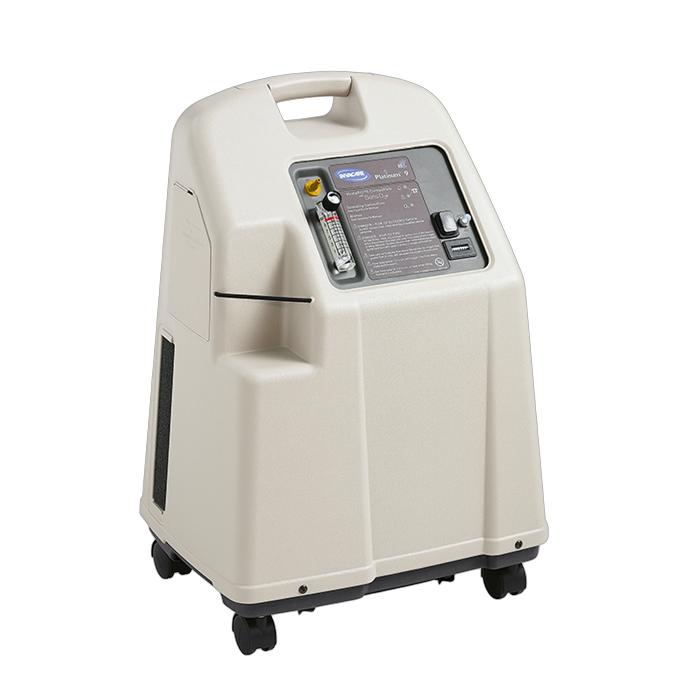

Key Takeaways
- Flow rate sets the category: Prescriptions of 5 LPM or below suit a 5L unit; above 5 LPM needs an 8-10L unit, and the flow rate drives price, power draw, and consumables.
- Purity is the quality marker: Look for a stable 93% +/- 3% oxygen concentration maintained across the full flow range, not just at low settings.
- Continuous flow, not pulse: Stationary units deliver continuous flow, which is what higher-flow and overnight prescriptions require.
- TGA listing is mandatory: The specific model must be ARTG-listed, and for funded patients the listed model must be approved under the relevant NDIS or DVA schedule before ordering.
- Concentrators beat cylinders on cost: A concentrator typically pays for itself against cylinder refills within 6 to 12 months for a regular home user.
A stationary oxygen concentrator is a long-term clinical asset, and choosing the right one starts with the prescription, not the price. Get the flow-rate category right and the unit meets clinical need for years; get it wrong and you either overspend on capacity you do not use or, worse, buy a unit that cannot maintain purity at the prescribed flow. This guide breaks down flow-rate selection, purity, TGA compliance, and supplier evaluation for 5L, 8-10L, and clinical-grade concentrators in the Australian market. It is written for home care providers, aged care facilities, respiratory clinics, and individual patients or their carers.
Start with the flow rate
Flow rate, measured in litres per minute (LPM), is the specification that sets everything else, so confirm the prescribed flow before comparing models. It determines the unit category, the purchase price, the power draw, and the consumable profile for the whole ownership period.
- 5 LPM or below: A 5L unit is the right category. This covers many supplemental oxygen needs, such as moderate COPD or emphysema.
- Above 5 LPM: An 8-10L unit is needed. Higher-flow prescriptions for more severe respiratory conditions require the larger unit's capacity.
- Continuous flow: Stationary units deliver continuous flow, which is what prescriptions above 5 LPM and overnight use require; pulse-dose delivery is a portable-unit feature and is not suited to continuous overnight therapy.
Match the unit to the prescription rather than buying up "to be safe": a 10L unit is heavier, draws more power, and costs more to run, so it is the right choice only when the prescribed flow genuinely calls for it. If the patient also needs oxygen away from home, weigh a stationary unit against a portable one using the stationary vs portable oxygen concentrator configuration guide before deciding.
Purity: the specification behind the flow rate
A flow rate is only meaningful if the unit maintains oxygen purity at that flow. The benchmark for a medical-grade stationary concentrator is a stable 93% +/- 3% oxygen concentration, and the key word is stable: a quality unit holds that purity across its full flow range, whether at 0.5 LPM or at its maximum. Be wary of units, often very cheap or mislabelled portable devices, that cannot maintain purity as flow increases, or that advertise a "1-10L" figure that refers to setting levels rather than true litres per minute. For a prescribed flow to be clinically useful, the unit must deliver it at the required purity, not just display the number.
| Prescription | Unit category | Typical purchase price |
|---|---|---|
| Up to 5 LPM | 5L stationary | $1,000 to $2,500 |
| Above 5 LPM | 8-10L stationary | $2,500 to $5,500 |
| Oxygen purity target | 93% +/- 3% stable | Across full flow range |
TGA compliance and funding
Compliance is a gate the purchase must pass before anything else. The specific model must be ARTG-listed as a medical device for use in Australia, so confirm the listing for the exact unit, not just the brand. For funded patients, there is a second step: NDIS and DVA equipment funding pathways can cover the full purchase cost for eligible patients, but the specific ARTG-listed model must be approved under the relevant schedule before ordering. Confirming both the ARTG listing and the funding approval upfront avoids ordering a unit that is either non-compliant or not reimbursable, which is a costly error to unwind after delivery.
Why a concentrator beats cylinders
For any patient on regular oxygen, the cost case against cylinder delivery is strong. A home patient using 2 LPM for 16 hours a day spends roughly $250 to $350 a year on electricity with a concentrator, versus $2,500 to $4,000 a year on cylinder refills, so the concentrator pays for itself within 6 to 12 months. Beyond cost, a concentrator removes the logistics of cylinder deliveries and the risk of running out. Annual running cost for a 5L home unit is around $350 to $700 all-in, covering electricity, filters, and an annual service, with 10L units running higher. This is why funded and home-based oxygen therapy increasingly favours concentrators over cylinder supply.
Supplier checklist
With the flow-rate category and funding pathway confirmed, shortlist verified suppliers through the stationary oxygen concentrator category, then assess each against the same criteria:
- ARTG listing: Confirm the exact model is ARTG-listed, and that it is approved under the relevant NDIS or DVA schedule if the patient is funded.
- Verified purity: Check the unit maintains 93% +/- 3% across its full flow range, not only at low settings.
- Noise level: For home and overnight use, a quieter unit (many run under 45 dB) matters for patient comfort and sleep.
- Warranty and service: Check warranty terms, including hours of operation, and whether servicing and sieve-bed replacement are supported locally.
- Fleet pricing: Providers managing five or more units can often secure 10 to 20% lower per-unit cost with bundled service contracts.
A realistic scenario
Picture a home care provider building a fleet of concentrators for NDIS and DVA-funded patients. The temptation is to standardise on a single high-capacity 10L unit for simplicity.
Checking the prescriptions changes the plan. Most patients are prescribed 5 LPM or below, so a 5L unit at $1,000 to $2,500 is the right category for them, and buying 10L units across the board would mean paying for capacity and power draw that most patients never use. The provider matches unit size to each prescription, confirms each model's ARTG listing and its approval under the relevant funding schedule before ordering, and checks that purity holds at 93% +/- 3% across the flow range. With five or more units, the provider negotiates fleet pricing with a bundled service contract. For the full cost breakdown including running costs and cylinder savings, see the stationary oxygen concentrator cost guide. Compare current models across the oxygen concentrator category, or the portable oxygen concentrator range where mobility is the priority.
Frequently asked questions
What flow rate stationary oxygen concentrator do I need?
It follows the prescription. A prescribed flow of 5 LPM or below suits a 5L unit; above 5 LPM needs an 8-10L unit. Flow rate is the specification that sets the unit category, purchase price, power draw, and consumables, so confirm the prescribed LPM before comparing models.
What oxygen purity should a concentrator deliver?
The benchmark is a stable 93% +/- 3% oxygen concentration, maintained across the full flow range rather than only at low settings. Be cautious of cheap or mislabelled units that cannot hold purity as flow increases, or that advertise a "1-10L" figure referring to setting levels rather than true litres per minute.
Does a stationary oxygen concentrator need to be TGA-listed?
Yes. The specific model must be ARTG-listed as a medical device for use in Australia, so confirm the listing for the exact unit. For funded patients, the ARTG-listed model must also be approved under the relevant NDIS or DVA schedule before ordering, so check both the listing and the funding approval upfront.
Is a concentrator cheaper than oxygen cylinders?
Usually, for regular users. A home patient at 2 LPM for 16 hours a day spends roughly $250 to $350 a year on electricity with a concentrator, versus $2,500 to $4,000 a year on cylinder refills, so the concentrator typically pays for itself within 6 to 12 months, while also removing delivery logistics and run-out risk.
Can NDIS or DVA fund an oxygen concentrator?
NDIS and DVA equipment funding pathways can cover the full purchase cost for eligible patients. The key step is confirming that the specific ARTG-listed model is approved under the relevant schedule before ordering, since a unit that is not approved under the pathway will not be reimbursed even if it is otherwise compliant.
What matters most
Choosing a stationary oxygen concentrator starts and ends with the prescription. Confirm the prescribed flow rate, which sets the 5L or 8-10L category and everything downstream, then verify the unit holds 93% +/- 3% purity across its full flow range rather than trusting the advertised number. Confirm the exact model's ARTG listing and, for funded patients, its approval under the relevant NDIS or DVA schedule before ordering. Match unit size to prescription rather than buying up, weigh the strong cost case against cylinders, and use fleet pricing where you manage several units. Get the flow-rate category right and the concentrator serves the patient reliably for years.
Ready to compare stationary oxygen concentrators? Get quotes from verified suppliers across Australia here.

-160x160-state_article-rel-cat.png)