
Key takeaways
Factor | Typical Range / Value | Buyer Implication |
|---|---|---|
Handheld / wireless probe |
$2,500 - $8,000 AUD |
Connects to tablet or phone; basic FAST scans and pregnancy checks |
Portable laptop-style (new) |
$8,000 - $25,000 AUD |
Suits mixed practices, mobile vets and clinics doing 3-10 scans per week |
Cart-based system (new) |
$25,000 - $60,000+ AUD |
Best image quality; multiple probe ports; suits clinics doing 10+ scans per week |
Revenue per ultrasound scan |
$80 - $350 |
Abdominal scans typically $150-$350; pregnancy confirmation $80-$150 |
Payback period |
6 - 18 months |
Faster at higher scan volume; 5+ scans per week recovers most systems within 12 months |
Annual running costs |
$500 - $3,000 |
Gel, probe maintenance, calibration; significantly lower than x-ray or CT running costs |
Probe replacement |
$2,000 - $12,000 per probe |
Probes are the primary consumable; lifespan is 5-8 years with proper handling |
Introduction
Ultrasound is the most cost-effective diagnostic imaging modality available to veterinary practices. Unlike x-ray, it uses no ionising radiation, requires no room shielding, no radiation licence and minimal installation. In 2026, portable and handheld veterinary ultrasound technology has dropped to price points where a single-vet practice can own a capable unit for under $10,000 and recover the cost within 6 months of regular use. Cart-based systems for higher-volume practices generate $40,000-$150,000+ in annual scan revenue with running costs under $3,000 per year.
This price guide covers what every category of veterinary ultrasound costs to buy, run and maintain in Australia, and models the revenue it generates against realistic scan volumes. Compare veterinary ultrasound machines from verified Australian suppliers on MedicalSearch once you have confirmed your system type and budget. For a broader overview of features and types, see the MedicalSearch veterinary ultrasound buying guide.
Clinics where this investment delivers the strongest return:
- Companion animal practices adding or upgrading diagnostic imaging capability
- Mixed practices needing both small animal abdominal and large animal reproductive scanning
- Equine practices offering pre-purchase and reproductive ultrasound in the field
- Emergency clinics using FAST (Focused Assessment with Sonography for Trauma) protocols
- Mobile vets wanting a portable unit that travels between locations
Choose your system type
Before costing anything, confirm which form factor suits your clinical volume, practice type and mobility needs. Your choice here sets the price bracket and image quality ceiling.
Type | Price Range (AUD) | Best For |
|---|---|---|
Handheld / wireless probe |
$2,500 - $8,000 |
FAST scans, pregnancy checks, field use; connects to tablet or smartphone |
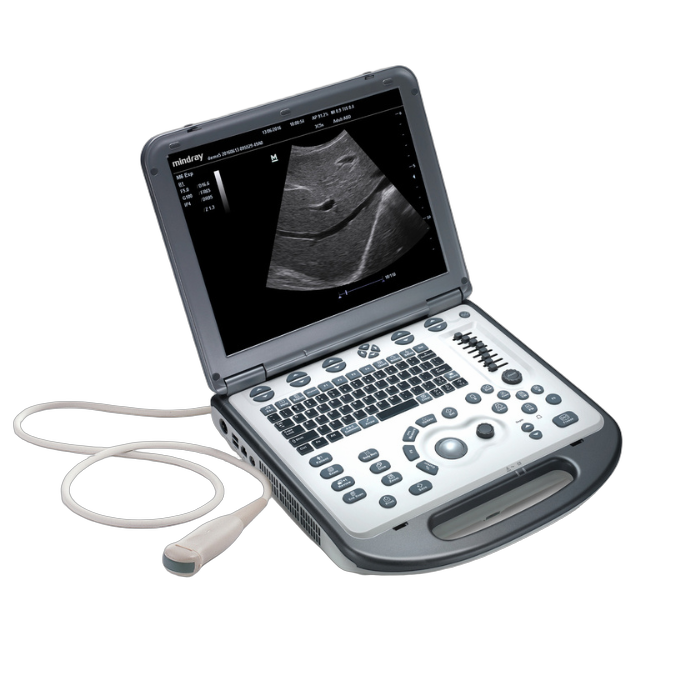
Portable laptop-style |
$8,000 - $25,000 |
Mixed practice, mobile vets, clinics doing 3-10 scans/week |
Cart-based system |
$25,000 - $60,000+ |
High-volume clinics, referral practices, cardiac and advanced abdominal imaging |
Choose a portable laptop-style system if your practice does 3-10 scans per week and needs portability between rooms or locations. This is the most popular category for Australian general practices. A $12,000-$18,000 portable unit with a microconvex and linear probe covers abdominal, reproductive and basic musculoskeletal imaging.
Choose a cart-based system if your clinic does 10+ scans per week or performs cardiac, advanced abdominal or referral-level imaging. Larger screens, multiple probe ports and advanced processing deliver diagnostic confidence that justifies higher session fees.
Evaluate the key specifications
With your system type confirmed, these are the specs that determine whether a given machine meets your clinical requirements.
Specification | Typical Range | Buyer Consideration |
|---|---|---|
Probe frequency range |
2-15 MHz |
Higher frequency (7-15 MHz) for cats and small dogs; lower (2-5 MHz) for large dogs and equine |
Probe types available |
Microconvex, linear, phased array, rectal |
Microconvex is the workhorse for abdominal; linear for superficial; phased array for cardiac |
Imaging modes |
B-mode, M-mode, Colour Doppler, PW Doppler |
Colour Doppler is standard on mid-range and above; essential for cardiac and vascular assessment |
Screen size |
5" (handheld) to 21" (cart) |
Larger screens improve diagnostic confidence; 15"+ preferred for detailed abdominal and cardiac work |
Image storage / export |
USB, WiFi, DICOM |
DICOM export integrates with PACS and practice software; confirm compatibility before purchase |
Battery life (portable) |
1 - 4 hours |
Field and mobile vets need 2+ hours; confirm runtime under active scanning, not standby |
Understand the full cost breakdown (2026 prices)
Purchase price is only part of the picture. Probe replacement and servicing are the primary ongoing costs, though they are significantly lower than x-ray or CT running costs.
Category | Price Range (AUD) | Notes |
|---|---|---|
Handheld / wireless probe |
$2,500 - $8,000 |
Single probe, connects to tablet/phone, basic imaging modes |
Portable laptop-style |
$8,000 - $25,000 |
Typically includes one probe; additional probes $2,000-$8,000 each |
Cart-based system |
$25,000 - $60,000+ |
Usually includes 1-2 probes; advanced models with 3D/4D from $45,000 |
Additional probes |
$2,000 - $12,000 each |
Microconvex and linear from $2,000; cardiac phased array from $5,000 |
Used / refurbished |
$3,000 - $30,000 |
Verify probe condition, image quality and software update status before purchase |
Annual servicing |
$500 - $2,000 |
Probe testing, software updates, system calibration |
Annual consumables (gel, covers) |
$200 - $1,000 |
Ultrasound gel and probe covers; minimal cost relative to scan revenue |
A mid-range portable system at $15,000 with one additional probe ($4,000) and $1,500/year running costs totals $26,500 in year one and $1,500/year thereafter. At 5 scans per week billed at $200 average, the system generates $52,000 in annual fee revenue. Payback is under 6 months, and the system delivers $48,000+ in net revenue per year from year two onward. Even a $50,000 cart-based system doing 8 scans per week at $250 average recovers the investment within 12 months. Request quotes from veterinary ultrasound suppliers on MedicalSearch to compare pricing across portable and cart-based configurations.
Depreciation and asset planning
Veterinary ultrasound machines carry an ATO effective life of 5-10 years depending on the asset class. The diminishing value depreciation rate is approximately 20-40%. Handheld and portable units under $20,000 qualify for the instant asset write-off for eligible businesses. Cart-based systems above this threshold are depreciated over the effective life.
Residual value at 5-7 years is 10-20% for cart-based systems from supported brands (Mindray, GE, SonoScape, Esaote) and near zero for discontinued models or brands without Australian service support. For practices uncertain about scan volume, equipment rental at $300-$1,500/month validates demand before capital commitment.
Evaluate suppliers
You are ready to go to market. Use this checklist to assess each supplier against the same criteria.
Factor | What to Ask |
|---|---|
Image quality demonstration |
Can the supplier demonstrate the machine on a live animal or comparable phantom at your clinic? |
Probe compatibility |
What probes are available for this platform, and can new probes be added later? |
PMS integration |
Does the system export images via DICOM to your practice management software? |
Training |
Is clinical and operational training included, and does the supplier offer ongoing scanning workshops? |
Probe replacement cost |
What does each probe type cost to replace, and what is the expected probe lifespan? |
Warranty |
What is the warranty period on the console and probes separately? |
Service in your state |
Is there a local service team in NSW, VIC, QLD, WA or SA? |
Software updates |
Are software updates included or charged separately? |
Loaner / trial |
Can the supplier provide a trial unit or loaner during repairs? |
Finance options |
Does the supplier offer lease, hire-purchase or rental arrangements? |
Frequently asked questions
How much does a veterinary ultrasound machine cost in Australia in 2026?
Handheld wireless probes start from $2,500, portable laptop-style systems from $8,000-$25,000, and cart-based systems from $25,000-$60,000+. Additional probes add $2,000-$12,000 each depending on type.
What annual revenue can a veterinary ultrasound generate?
At 5-10 scans per week billed at $150-$350 each, in-house ultrasound generates $40,000-$180,000 per year in direct fee revenue. Running costs are under $3,000/year, making ultrasound one of the highest-margin imaging modalities.
Does a veterinary ultrasound require a radiation licence?
No. Ultrasound uses sound waves, not ionising radiation. There is no radiation licensing, room shielding or compliance testing required. This is a significant cost and complexity advantage over x-ray.
How long does a veterinary ultrasound machine last?
The console typically lasts 7-12 years with regular servicing. Probes are the primary wear item, lasting 5-8 years with careful handling. Budget for probe replacement at $2,000-$12,000 per probe over the machine's life.
Should i buy new or refurbished?
Refurbished units at $3,000-$30,000 offer significant savings but carry risk on probe condition and software support. For a primary diagnostic system, new is safer; refurbished suits backup units or practices validating demand before investing in new equipment.
Summary
- Handheld probes from $2,500; portable systems from $8,000; cart-based from $25,000-$60,000+ (AUD, 2026)
- Annual running costs are $500-$3,000, significantly lower than x-ray or CT
- In-house ultrasound generates $40,000-$180,000+ in annual fee revenue at moderate volume
- No radiation licence, room shielding or compliance testing required
- Payback is typically 6-12 months at 5+ scans per week
- Probes are the primary ongoing cost item at $2,000-$12,000 per replacement
Ready to source your veterinary ultrasound machine?
Don't waste time contacting suppliers individually. MedicalSearch gives you direct access to verified Australian veterinary ultrasound suppliers - compare models, specs and pricing in one place, then request quotes from suppliers best matched to your clinic.
- Compare models - filter by system type, probes and region
- Request quotes - contact multiple verified suppliers with a single enquiry
- Contact suppliers directly - speak to specialists who service your state
→ Compare Veterinary Ultrasound Machines on MedicalSearch Now →