
Key takeaways
- Size on your busiest day: average volume hides the bottleneck. Count the sets you turn over on your heaviest session, then work back to chamber size.
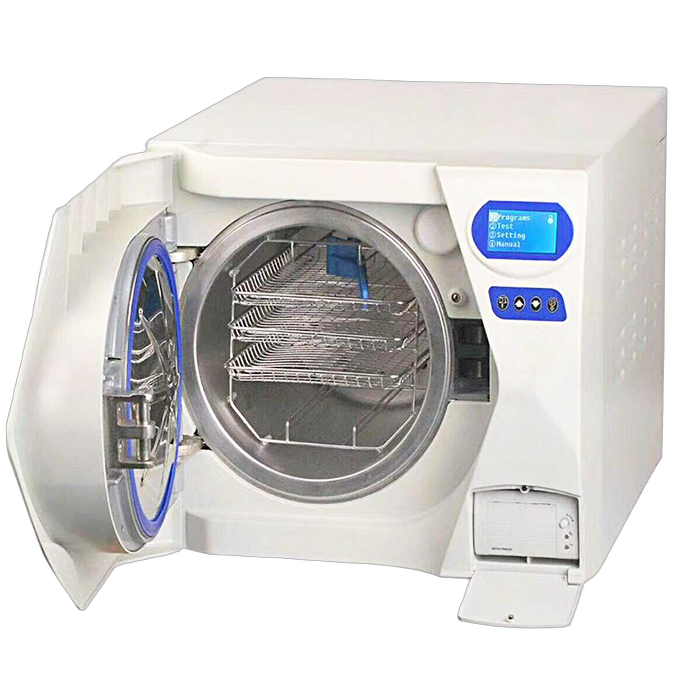
- Chamber litres are not usable capacity: a 23L chamber may hold three trays or five depending on tray design, so compare tray dimensions and maximum load weight.
- Cycle time sets your throughput: a full wrapped cycle runs roughly 35 to 45 minutes including drying, which caps how many loads you can process in a session.
- Traceability is a purchase decision: cycle records, batch labelling and data export are cheaper built in than added later.
- Servicing decides your downtime: guaranteed response time and a loan unit matter more than the price gap between quotes.
Choosing a dental autoclave on workload, not price
Sterilisation is the narrowest point in most dental practices. When the steriliser cannot keep pace, chairs sit idle waiting on instruments, and the practice buys its way out with extra sets or a longer day for the nurse. Both cost more than the gap between two quotes.
This guide covers how to compare dental autoclaves in Australia on instrument volume, usable capacity, cycle times, traceability, servicing and compliance, so you can match a system to your busiest day rather than your average one.
Peak-day instrument volume
Start with a count, not a catalogue. For your busiest recent day, record how many instrument sets each chair turned over, add hygiene sets, handpieces and surgical trays, and note the hours those sets had to be ready within.
That number gives you loads per session. A two-chair practice running restorative work might turn over 20 to 30 sets a day, while a four-chair practice with a hygienist and implant sessions can pass 60. The second does not need twice the chamber, it needs enough cycles inside the working day.
Cycle class and the loads it can process
Steam sterilisers are graded by how well they remove air from the chamber before steam enters, because trapped air stops steam reaching inside hollow items such as handpieces. The grades come from EN 13060, the small steriliser standard.
| Cycle class | What it can process | Role in a dental practice |
|---|---|---|
| Class N (gravity) | Solid, unwrapped instruments only | Not adequate as a practice's only steriliser |
| Class S | Solid plus specific wrapped or hollow items named by the manufacturer | Useful second unit for fast turnaround of defined loads |
| Class B (pre-vacuum) | Wrapped, hollow and porous loads, including handpieces | The main steriliser in almost every dental practice |
If a Class S unit is quoted lower, read its approved load list before comparing it to a Class B quote. The two are not doing the same job.
Usable capacity versus chamber litres
Chamber volume is the headline number and the least useful one. Two 23L chambers can carry three trays or five depending on tray depth and shape, and pouched sets usually hit the maximum load weight before they fill the space.
| Specification | Typical range | What to check in the quote |
|---|---|---|
| Chamber volume | 12L to 23L benchtop | Litres alone do not tell you what fits |
| Trays supplied | 3 to 5 in a 23L chamber | Ask for tray dimensions, not just the count |
| Maximum load | Stated in kg by load type | Wrapped loads have a lower limit than solid ones |
| Cassette fit | Varies by tray width | Test your own cassettes before you sign |
| Drying method | Vacuum, heated jacket or both | Damp pouches fail the load and force a rerun |
Cycle times and daily throughput
A full wrapped Class B cycle commonly runs 35 to 45 minutes including drying. Fast cycles for defined loads finish in 11 to 20 minutes, but carry restrictions on what may go inside, so treat the fast figure as a bonus, not your planning number.
Divide your working hours by the full cycle time, then allow for loading, unloading and cooling. An eight-hour day at 45 minutes a cycle realistically gives eight to nine loads, not ten. If your peak-day set count exceeds what those loads carry, the fix is a larger chamber, a second unit or more instrument stock. Compare all three before you get quotes for dental autoclaves.
Traceability and cycle records
Every sterilised load needs a record showing the cycle ran correctly and what it contained. Compare how each unit produces that record: internal printer, USB export, network upload, or a label printer that puts a batch number and expiry date on each pouch.
Ask whether batch labels can be linked back to the patient record, since that link is what turns a cycle log into usable traceability. Check which daily tests the unit runs and records, including the start-of-day steam penetration test (Bowie-Dick test) and the narrow-tube test for hollow loads (helix test). Retrofitting documentation onto a unit that only prints a paper tape never fully closes the gap.
Servicing, support and the supplier checklist
A steriliser out of action stops the practice. Put the same questions to every supplier.
| Factor | What to ask |
|---|---|
| Response time | Guaranteed on-site attendance time in our postcode |
| Loan unit | Is a replacement supplied if ours is out for repair, and how fast |
| Annual service | What the yearly service and performance testing include, and the cost |
| Water supply | Tank fill or plumbed, and which water treatment is required |
| Installation | Bench clearance, drainage, ventilation and power requirements |
| Warranty | Term, what is excluded, and whether labour is covered |
Cleaning throughput sets how fast instruments reach the steriliser, so check your ultrasonic cleaner capacity at the same time. Practices sizing a larger floor-standing unit should read the large autoclave buying guide. Purchase price and running costs sit in the autoclave price guide, where most dental buyers land between $9,500 and $16,000.
Australian compliance requirements
- AS 5369:2023 replaced AS/NZS 4815:2006 and AS/NZS 4187:2014 in December 2023, and now covers dental practices as well as hospitals.
- Advisory PCHS24/01 required accredited practices to complete a gap analysis against AS 5369:2023 by 30 June 2025.
- The unit must be included on the Australian Register of Therapeutic Goods (ARTG). Ask for the ARTG number.
- Water quality must meet defined limits and be tested, so confirm the water treatment the unit requires before installation.
- Australian Dental Association infection prevention and control guidelines sit alongside the standard, and load records must be retained. Check your state health department for retention periods.
Frequently asked questions
What size autoclave does a three-chair dental practice need?
Most three-chair practices run a 23L Class B unit, provided instrument stock covers a full cycle. Add a second unit rather than a bigger chamber if your peak day needs more loads than working hours allow.
Is a Class S autoclave enough for a dental practice?
Not as the only steriliser, because handpieces and wrapped sets need the air removal a Class B cycle provides. A Class S unit works well as a second machine for the load types its manufacturer has approved.
Should we run one autoclave or two?
Two smaller units give redundancy and let you run a fast load alongside a full one, which suits practices that cannot stop when a machine faults. One larger unit is simpler to operate and service, and suits practices with a loan unit arranged.
How much instrument stock do we need to avoid waiting on cycles?
Hold enough sets to cover the full loop of cleaning, packing, sterilising and cooling at your peak booking rate. Practices short on stock usually need roughly one and a half times the sets used in the longest session.
What records do we have to keep for each load?
Keep cycle data showing time, temperature and pressure, plus load contents, operator and monitoring results. Batch labelling that links a pouch to a patient record is what makes a load traceable after the fact.
What matters most
Work in this order: count your peak-day sets, convert that to loads per session at a realistic full cycle time, then find the smallest system that clears it with room to spare. Only then compare quotes. A unit that saves a few thousand dollars but forces a fifth load into a four-load day will cost that saving back in idle chair time within the first year.
Ask every supplier the same questions and compare the answers side by side. Get and compare dental autoclave quotes now from Australian suppliers, where medical and dental buyers request and compare multiple quotes so they can buy with confidence.